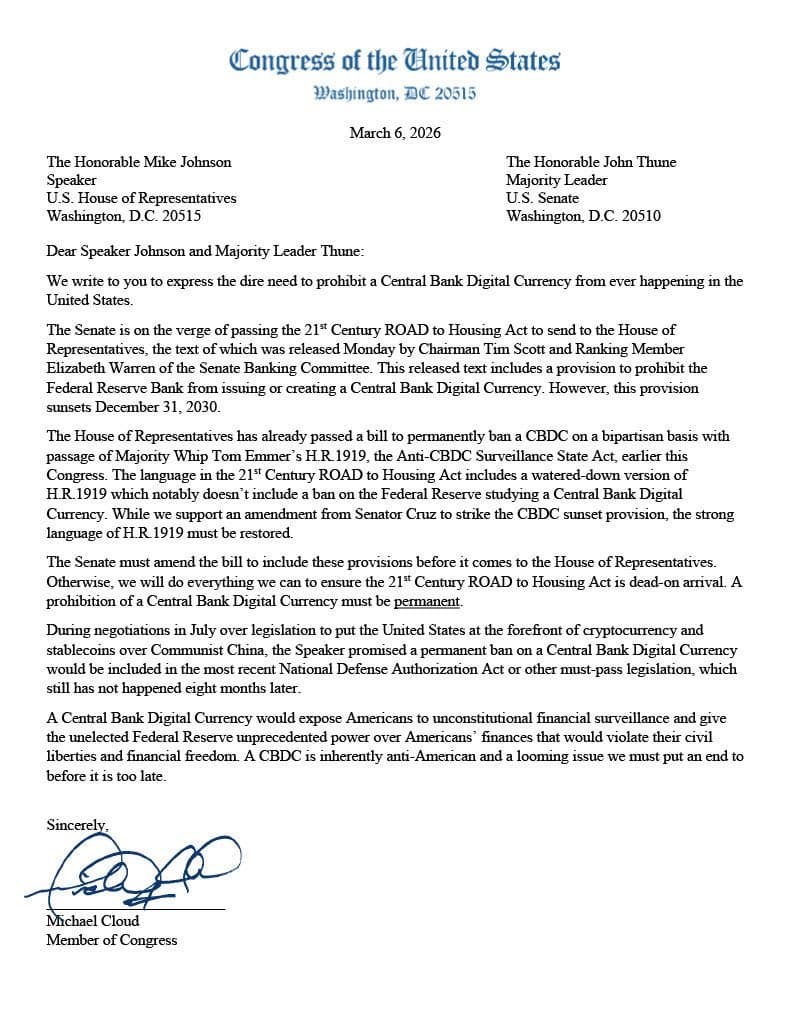
Another critical measure achieved in the House’s 21st Century ROAD to Housing Act is language prohibiting the federal government from implementing a Central Bank Digital Currency (CBDC) through 2030.
A CBDC threatens the financial privacy of every single American, and I will sure this provision is made permanent.

Rep. Russ Fulcher
@RepRussFulcher
There is excellent news for American homebuyers.
The bipartisan 21st Century ROAD to Housing Act is one step closer to becoming law after passing the House once again and heading back to the Senate.
This legislation helps make homeownership more attainable for hardworking tly regulations, advancing reforms to encourage affordable housing construction, and leveling the playing field for everyday buyers by limiting large institutional investors from purchasing single-family homes in bulk.
I’m proud to vote yes on this bill and look forward to its enactment.
Very Pro-CryptoAdd commentary on this stance
Commentary on Stance

The Representative from Idaho's 1st district just highlighted a massive legislative win for financial privacy, correctly earning a perfect stance score of 100 for his latest comments.
At first glance, the bipartisan 21st Century ROAD to Housing Act is primarily focused on making homeownership more attainable. The bill cuts costly regulations, promotes affordable housing construction, and levels the playing field for everyday buyers by restricting large institutional investors from purchasing single-family homes in bulk. But tucked inside this legislation is a crucial, pro-freedom victory for digital asset advocates: a provision that strictly prohibits the federal government from implementing a Central Bank Digital Currency through 2030.
It is vital to understand the stark difference between true cryptocurrencies and a CBDC. Decentralized networks like Bitcoin empower individuals through permissionless, open systems. Privately issued stablecoins extend the utility of the dollar and are a massive net positive for humanity. In contrast, a CBDC is a tool for state surveillance and control. It is programmable government money that would give federal authorities unprecedented access to monitor your transactions, restrict your spending, and potentially debank political opponents. Banning the creation of a retail CBDC directly protects the financial freedom of every American.
The Idaho Congressman has been an incredibly consistent warrior on this specific front. He currently holds an overall stance score of 61. While his voting record has a notable flaw—specifically his vote against the GENIUS Act in July 2025, which would have established a much-needed clear regulatory framework for stablecoins to thrive—his anti-surveillance credentials are rock solid. He has consistently voted to repeal invasive DeFi tax reporting rules, supported clear rules of the road with the CLARITY Act back in July 2025, and previously backed permanent bans on CBDCs.
We need to encourage the proliferation of free-market digital assets, not central bank tools of control. Ensuring the federal government cannot weaponize the financial system against its citizens is a baseline requirement for a free society, and cementing this legislative roadblock through 2030 is exactly the kind of defense the industry needs.